
The PLAY+ Game Loop | 3 Loops in One
Beyond the Map: Process, Requirements, and the Hidden Generative Loop
I recently laid out the PLAY+ Game Loop. It lays out a framework for game creation and game dynamics. In this piece, I’d like to lay out some of the mechanics that are going on within the loop. In the previous piece I mentioned that it is both a process and the requirements for games. I’d like to go a little deeper and tease out some of the mechanics and logic that are happening within the loop. Let’s go!
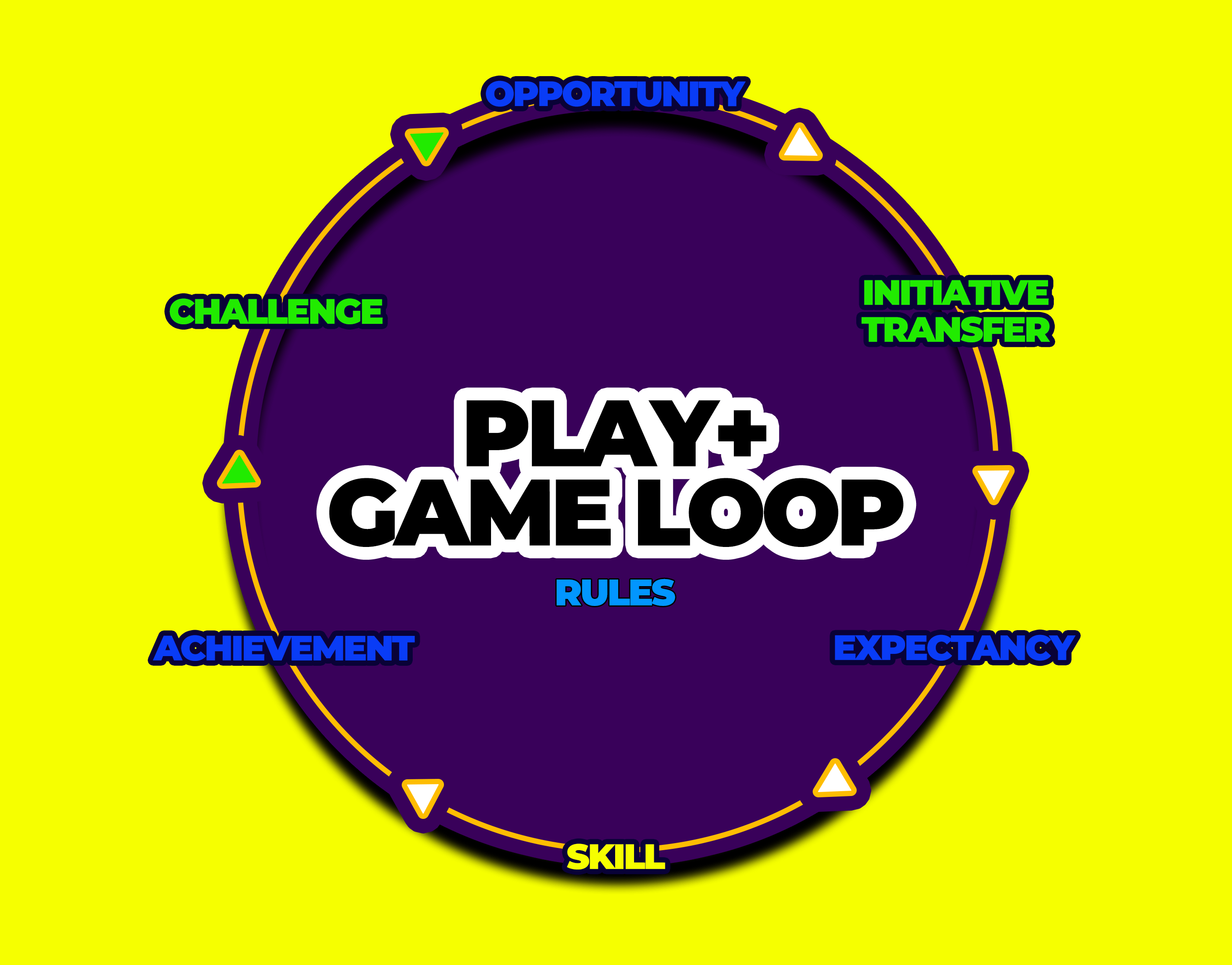
In the PLAY+ images and diagrams, colors have meaning: Blue is physical-Awareness and green is mental-Attention. Yellow is intention or purpose. In the image above you can see 2 internal loops: Opportunity | Expectancy | Achievement and Challenge | Initiative Transfer | Skill. I know skill is yellow here, it is kind of a special aspect (I will probably wind up changing it to green after writing this).
So we have 2 loops clearly identified: OEA and CIS. There is a third loop that is not evident, and it is this loop that is the most important for creating a game on the fly or for playing the game and playing it well. We’ll hit on that one at the end… stay tuned, it’s the most important part of playing games to develop skills. You don’t want to miss it…
Opportunity | Expectancy | Achievement - the Metaphysics of PLAY
Metaphysics is the fundamental nature of reality, existence, and the universe. Sounds heavy, right? It is. It is literally beyond physics.
The Metaphysics of PLAY, the fundamental reality and existence of it, is Opportunity | Expectancy | Achievement. If you’ve got those 3 things and it’s safe to fail, you’re likely to experience PLAY. Without the safe to fail aspect you have a very high stakes challenge; it might be existential. Do or die play isn’t really fun. Remember, nobody cares about this rep… unless it’s the world finals or the qualifier for the world finals.
Opportunity - The Reason to PLAY
Opportunity is the reason to play. When Opportunity becomes obligation, you’re not playing, you’re doing something else.
Opportunities are not transactions or propositions. They’re not, “If I do this, I get that.” Opportunities are not pure possibilities either; it’s not an anything is possible type thing; that is a dream or a wish.
Opportunities are about potential in the moment: there is this situation in front of me, if I do it something amazing might happen. The end result of an Opportunity is a possibility, but to treat them as if anything is possible is to get stuck without an actionable path forward. We have to have the ability to jump on the Opportunity.
Opportunities are time sensitive. You have to act on them or they go away and are missed. An Opportunity that must be taken is an obligation and is antithetical to PLAY.
For a game to be fun and engaging requires an Opportunity. All games start with a question, the question that starts the game is an Opportunity that everyone should want to take.
Expectancy - The Procedural Engine of PLAY
Expectancy holds the process of PLAY together. Good rules, good consequent interaction, and good results are expected by the agents playing the game. “This is how we do it.”
Expectancy is knowing the potential of the Opportunity, it’s often surprised but it’s never clueless. We have to know how to proceed; how to capitalize on the Opportunity.
Expectancy is embodied in the action of games and deeply embedded in biology. In affective neuroscience, expectancy is the engine that drives intrinsic motivation and our primal emotional drives. Games play on that Expectancy and do so within the rules in a safe to fail fashion. Rough and tumble play between rats depends on Expectancy for safe and engaging interaction. It recognizes the potential, organizes our actions, and should limit the possibilities of PLAY. If something happens that is beyond the pale or completely unexpected — out of left field, it can shatter Expectancy. If the little rat really gets beat up, the game is broken.
Expectancy is knowing how things should go down and anticipating how they will go down. If we can track it like that and it looks or sounds fun, we want to play it. There is an aspect of hope or desire in Expectancy, so while it requires and does do pattern recognition, simply running a pattern will not deliver Expectancy.
There is a fine line between the unexpected and the ill-fit and the expected and the pattern. Expectancy walks that line.
Achievement - The Satisfaction Condition of PLAY
Achievement in PLAY is not doing the thing, it’s having played successfully. Michael Jordan missed half of his shots and lost a lot of games. Tiger Woods missed 30% of the fairways he shot at the pinnacle of his career. The best hitters in baseball failed to get a hit 70% of the time. Soccer games often wind up in 0-0 ties. Achievement in PLAY is having gone through the process and played the game well.
We have been level set poorly on this by pop culture and the commodification of performance; the packaging up of performance into step by step How-to formats. Achievement doesn’t work like that. We have to miss sometimes to feel Achievement if it always happens it’s not Achievement.
Framing Achievement properly is key for players and coaches alike.
Challenge | Initiative | Skill - The Relational Ground of PLAY
The second loop within the Game Loop is the relational aspects of PLAY in series. This is how agents within the game work together and within the environment to have fun and explore within the rules set.
Challenge - Set It and Remember It
The Challenge has a few functions. It sets up the game, it evaluates how the game is playing out, and it sets up the next Opportunity as the game plays out.
Before the game starts (or continues), a Challenge is set (or reset). This Challenge can be seen as the point or the goal of the game. Basketball has a challenge. Scrabble has a challenge. Score points. The rules set up how the Challenge plays out.
The situation on the ground: Who is playing? What are the stakes? Where are we playing? What tools or equipment is on hand or in hand? All of these things dictate the scale and scope of the Challenge and must be taken into account before the start of the game or before the next Opportunity can happen. This is going to happen to start the game and, depending on the game, will happen at declared times or in flow as the Game Loop rolls on.
After we’ve gone through the process of the loop: Opportunity → Initiative → Expectancy → Skill → Achievement the first thing the Challenge needs to do is to evaluate what’s happened so far. Reflect upon the Achievement: How did that go? Can we keep going? Do I need to make any changes? This is similar to setting the initial Challenge before the game but it often happens in flow and is taking into account where the game sits right now.
Which brings us to the second function of the Challenge, also resonant with the game start: What’s the situation on the ground? Where are my discs? How many discs do I have in hand? Which way is the dog facing? How are we in relation to the wind? This moment is key to flowing play. This may or may not happen after a skill is performed or may have a set time and situation where the Challenge can take place. In Basketball, there is an inbounds pass after every shot made or when the ball goes out of bounds. This is a moment of Challenge.
The last thing that needs to happen is that a new goal or revised goal is set that takes into account the situation on the ground and our reflection upon the Achievement. Once we’ve done all that, we’re prepared for, level set, and oriented to the next Opportunity. Let’s GO!
Initiative (Transfer) - The Agency, Control, and the Intent to Act
Initiative is both the agency and control to act. In many games, and when we’re talking about cooperative play, Initiative transfers between players. This Initiative Transfer is a key moment in the game. It is what sets the play in motion and decides who or what is leading the action.
In turn based games, this is simply a matter of who has the dice or who plays a card first. But in cooperative games this moment is much messier as it is often up for grabs or requires some sort of negotiated transfer of Initiative. This moment is do or die for the game. It’s either deal-maker or deal-breaker. In a well crafted cooperative game, a game that is fun to play, this moment requires skill; Initiative Transfer is a key skill in cooperative play.
From the previous piece on Game Dynamics:
“I paused, using the marker that created the Opportunity as an Expectant Marker. This filled the gap between Opportunity and the Initiative Transfer, and Merk was stuck. So he came off the toy with his gaze and hit me with some Eye Contact. I marked it and iced him again before popping the toy out.”
I could have called Merk to get some Eye Contact, but then he wouldn’t know how to perform the Initiative Transfer or that Initiative could be transferred. He wouldn’t know that I was as valuable as the toy or that the access to the toy came through interaction with me. He wouldn’t have performed Initiative and wouldn’t understand that he could make things happen or that he could affect his consequence with initiative. Merk needed that sense of agency and Achievement to want to do the skill. Besides it’s hard to play games with a dog who doesn’t know they have agency.
Launching forward with Expectancy or with the ability to be successful is often completely dependent upon Initiative or Initiative Transfer. If this stage of the game doesn’t go well, the action starts with a miss and it’s hard to recover from a bad start.
Skill - We’re Doing It!
It’s the moment of truth — we’re doing it! When we’re not talking about games and not thinking clearly about what actually happens or only thinking in terms of behavior, this is the only moment that matters. This is a mistake.
If we’re simply doing a behavior the Challenge had to be set accordingly and the Initiative must be situated within the agent or team. Only then can the behavior be performed and success or failure determined. When we’re playing or playing a game Opportunity → Intiative → Expectancy have all taken place. Are those moments resonant with the skill? If they are, the skill is likely to go off. If not, it’s likely to fail.
A skill is an action or behavior adapted to fit the situation. Challenge and Initiative are required to both do and successfully adapt the behavior to fit. This is rarely accounted for in the cookie cutter idea that we’re just “doing behaviors” or that they just happen. Behaviorism treats skills and behaviors the same: discrete motor patterns triggered by antecedents. But skills are adaptive responses emerging from relational context - they literally can’t exist without CIS.
CIS is the relational process and space that is required to successfully do anything with intent and the presuppositions that success or failure are dependent upon.
Achievement | Challenge | Opportunity - The Hidden Loop of Change & Recovery
ACO is at the end of the Game Loop. This is where we reflect, evaluate, and plan for next. Centered upon and extending the Challenge, ACO, is the value proposition loop of the game. The reality of gameplay is the Challenge process bridges 3 stages of the game and crosses over the OEA and CIS loops and this is where good games are made and sustained, or broken and crash & burn.
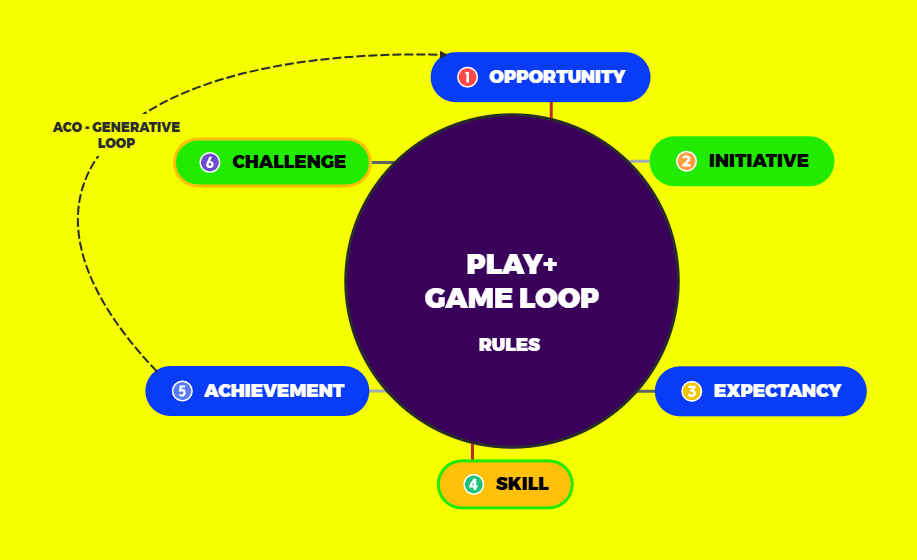
While the loop has a sequence, you might recognize that the Challenge needs adjustment at any moment. When that happens, address it between skills rather than pushing through to failure. The Challenge spot after Achievement is where this reflection formally happens, but the need for adjustment is often recognized on the fly.
The Achievement should be the completion of a legitimate Challenge. We want to scale that Challenge to test skills. Essentially, we’re making a judgement on the type or value of the Achievement: is the juice worth the squeeze? Is it too easy? Too hard? Are we ready to move on? Did that work? Did that accomplish what we needed it to?
The decision on the Challenge stage sets the next Opportunity, too. Make a good decision here and we’ve got a great Opportunity moving forward, make a bad one and we might tank the game. And that’s cool. Nobody cares about this rep unless it’s the World Finals or the Qualifier for the World Finals. It ain’t nothing but a thing…
Opportunity and Achievement are tied together by the Challenge posed. Achievement isn’t a given; making the shot is only valuable if you can miss. Opportunity isn’t a given, if you don’t jump on it it will go away and nobody promised you it would work out. A properly set challenge will make Achievement both a worthy goal and proper motivation.
This ACO loop is what creates the value and flexibility of the game. It is the tunable motivation for playing this game. This tunable motivation is the difference between work and play; between training and playing. Done well, ACO will turn the dog on and create motivation to play the game. Behaviorists think it is the cookie makes a behavior valuable. ACO reveals the reverse: skilled interaction within a well-tuned game IS the cookie.
Go Do Dog Stuff…
The Game Loop helps you structure games and navigate game dynamics, both as a coach planning sessions and as a player making decisions on the fly.
We’ve hit on the 3 loops inside of it:
OEA gives you the dispositional ground of PLAY itself - Opportunity | Expectancy | Achievement. This is why the game feels like play rather than work.
CIS gives you the relational process of cooperation - Challenge | Initiative | Skill. This is how you and the dog actually do things together.
ACO gives you the generative engine that keeps games alive - reflecting on Achievement, adjusting Challenge, creating new Opportunity. This is what turns play into skill development and creates the value that makes games worth playing and the flexibility to keep things moving and develop skills.
The Game Loop isn’t just a map of how games work - it’s a flexible framework for making games that adapt to reality. OEA gives you the reason to play, CIS gives you the method to play together, and ACO gives you the flexibility to keep playing when things inevitably go sideways.
Here’s how to use this: Next time training stalls, ask which loop is broken. No motivation? Check OEA. Dog won’t engage? Check CIS. Game getting stale? Check ACO - that’s where skill development actually happens through tunable Challenge.
Skills are behaviors adapted to fit. The Game Loop is how that adaptation happens through play rather than drill.
Go make some games.
Join my classes by becoming a Patron of Pawsitive Vybe - or join the substack here – it is embarrassingly cheap. Stay tuned... This place is gonna drop some serious content even for freebie-friends, so subscribe in order to keep up with the happenings & opportunities to play.
Peace & Happy Jamming!